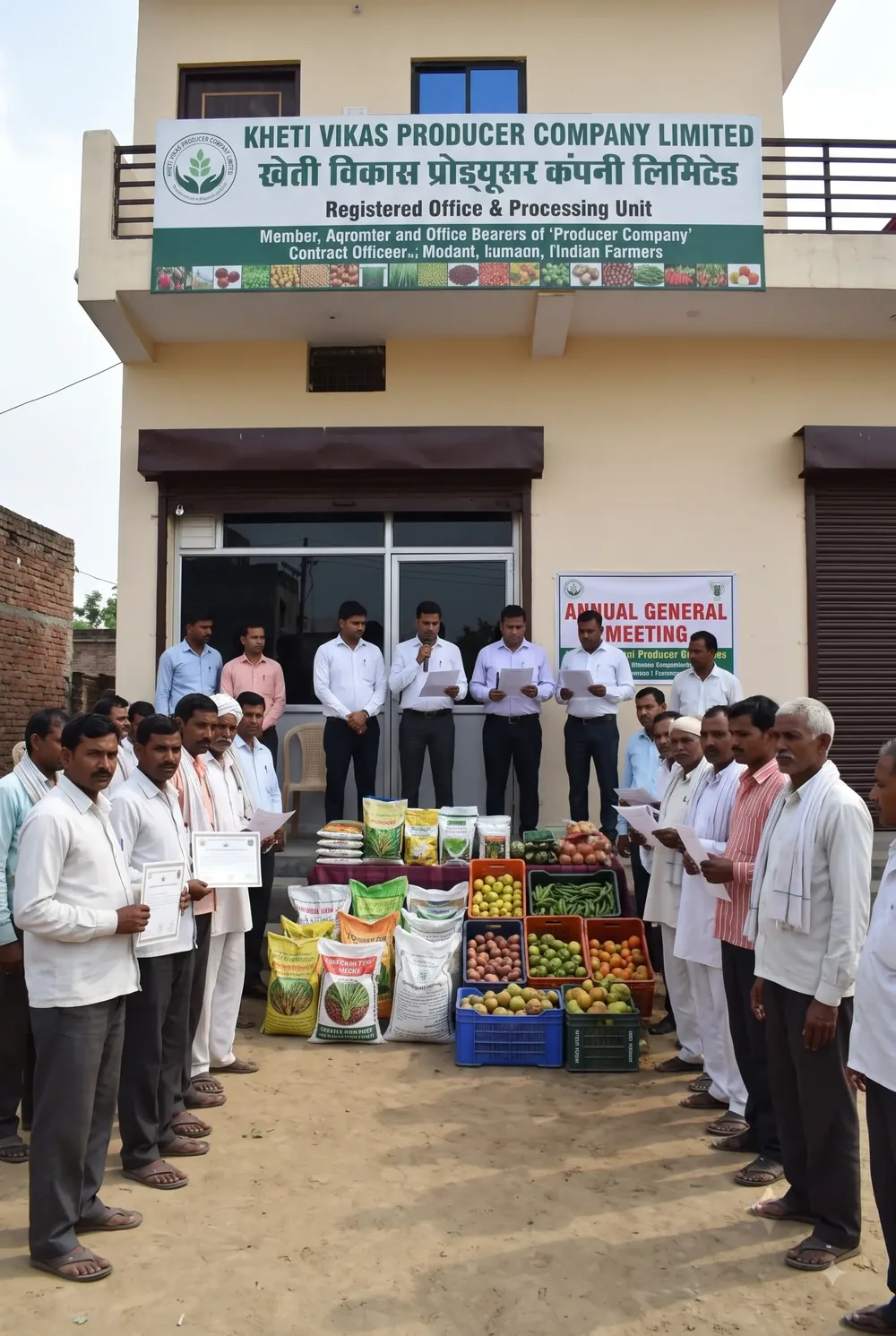
First Image
SPECIAL CATEGORY PRICING

PRODUCER COMPANY REGISTRATION

BASIC PLAN

LAUNCH PRODUCER CO

₹29,999 + GOVT. FEES
  • Best for: Straightforward setups with 10 individual producers or 2 producer institutions.
  • Eligibility review (members/objects) & name availability search.
  • DSC & DIN for up to 5 directors.
  • Drafting & filing: SPICe+, eMOA/eAOA, AGILE (PAN/TAN, EPFO/ESIC/GST as applicable).
  • Producer-centric MOA/AOA templates and declarations.
  • Certificate of Incorporation, PAN, TAN.
  • Filing by the experienced expert.

ADVANCE PLAN

REGISTER, OPERATE & COMPLY

₹49,999 + GOVT. FEES
  • Best for: Setups needing documentation depth, banking/GST readiness, and governance support.
  • Everything in Basic Plan, plus:
  • Drafted board & member resolutions (appointment of CEO, opening bank account, issue/allot shares).
  • GST registration assistance (govt. fee extra) and invoice templates.
  • Statutory registers (members, shares, directors) & share certificate issuance kit.
  • One compliance setup session (60 mins) + priority query handling for 30 days.
  • Bank account opening assistance, GST certificate (if opted).
  • 12-month compliance calendar (AGMs/returns/filings) and checklist.

Please note: All prices exclude GST. Government fees are additional for online legal service.

Readiness Check — 45 seconds

Are you ready to incorporate?

Q1. Do you have 10 individual producers or 2 producer institutions?
Q2. Objects are in primary production (agriculture, dairy, fisheries, forestry)?
Q3. KYC & address proofs (not older than 2 months) available?
Answer the questions to see readiness.

We handle name, DSC/DIN, SPICe+ filing, producer-centric MOA/AOA, PAN/TAN, statutory registers, GST (opt-in), and one-year compliance map — 100% online.

✔ Minimum ten producers or two producer institutions
✔ Agriculture / forestry / dairy / fisheries & allied activities
✔ Private Ltd structure (without “Private” in the name)
0
setups coordinated
0
states & UTs
0
% on-time filings
End-to-End Process
1) Eligibility & Name
Eligibility review, name search, reservation on MCA.
2) DSC & DIN
DSC for up to 5 directors and DIN activation (as needed).
3) Drafting
Producer-centric eMoA/eAoA, declarations (INC-9, DIR-2, MBP-1).
4) Filing
SPICe+ Part B + AGILE (PAN/TAN/EPFO/ESIC/GST if opted).
5) Approval
COI issued, PAN/TAN allotted; statutory registers starter kit.
6) Post-Inc
Bank A/c, share issue/allotment, GST assistance, 12-month calendar.
  • Minimum 10 individual producers or 2 producer institutions (or a combination).
  • Primary production activities: agriculture, horticulture, forestry, dairy, livestock, fisheries, etc.
  • Registers only as a Private Limited company but without the word “Private” in the name.
  • At least two directors (practical: 5 is common for governance).

We provide producer-specific MOA/AOA templates & declarations to avoid MCA queries.

  • Valid address proof (utility bill ≤ 2 months), Rent Agreement/Sale Deed, and Owner NOC (if rented).
  • Bank account opening support and board/member resolutions for issue/allotment of shares.
  • Identity: PAN (mandatory), Aadhaar, Passport (foreign nationals).
  • Address: Passport / Voter ID / Aadhaar / DL + latest utility bill (≤ 2 months).
  • Photos: Clear, recent (digital).
  • INC-9 (subscribers & directors), DIR-2 (consent), MBP-1 (interest disclosure).
  • Affidavit under Rule 15 and professional certification (CA/CS/CMA).
  • DSC for all directors; DIN (if new) along with SPICe+.
  • Self-declaration from each member confirming producer activity.
  • Optional: 7/12 extract (landholding), income certificate, FPO membership.
  • Producer-company MOA & AOA aligned to Companies Act, 2013 (Chapter IXA).
Smart Checklist

Build your to-do pack

User Stories
“Eligibility to AGM calendar in one track. Bank and GST were done without running around.”
Director, Horticulture FPO • Maharashtra

Ready to launch your Producer Company?

Second Image
Producer Company — Easy Guide Flipbook Incorporation • Law • Practice (India)
Start

Producer Company — Law & Practice (India)

1) Legal origin & status

Current statute: Companies Act, 2013, Chapter IX-A (Sections 378A–378ZU) — inserted by the Companies (Amendment) Act, 2020 (brought over, with updates, from Part IX-A of the 1956 Act).

Nature: A company limited by shares registered as a Producer Company. In name it ends with “Producer Company Limited” but, for most compliances, it is treated like a Private Company unless Chapter IX-A provides otherwise.

Co-operative principles inside company law: “One member–one vote”, patronage bonus, restricted transfer of shares, focus on member services rather than pure return on capital.

1
Page 1 of 10

2) Who can form it (Eligibility)

You can incorporate a Producer Company with any one of the following subscriber groups:

  • Ten (10) or more individual “producers”, or
  • Two (2) or more “producer institutions”, or
  • A combination of 10 individual producers + producer institutions.

Producer = any person engaged in a “primary produce” activity (agriculture, horticulture, floriculture, viticulture, pisciculture, animal husbandry, forestry, sericulture, bee-keeping, handloom/handicraft allied to primary produce, etc.).
Producer institution = a co-operative society/producer company/any body corporate having producers as members and engaged in activities connected with primary produce.

Name rule: Must end with “Producer Company Limited” (do not use the word “Private” in the name).

2
Page 2 of 10

3) Permissible objects (what a Producer Co. can do)

(Ref. Section 378B) — Objects are exhaustive. Your MOA must restrict itself to these, such as:

  • Production, harvesting, procurement, grading, pooling, handling, marketing, selling, export of members’ primary produce; import of goods/services for members.
  • Processing: preserving, drying, distilling, brewing, vinting, canning, packaging, etc.
  • Manufacture/sale/supply of machinery, equipment, or consumables to members.
  • Education, technical services, training, R&D, consultancy to members.
  • Power generation, transmission, distribution for primary produce.
  • Insurance of producers, their primary produce or assets.
  • Welfare measures, mutual assistance principles, and financing procurement/marketing/processing activities of members (credit facilities subject to the Act/AOA).

If your intended activity is outside Section 378B, it cannot be a Producer Company object.

3
Page 3 of 10

4) Capital, membership & voting

Share capital: Only equity shares; issuance/redemption governed by AOA and Chapter IX-A. Limited return on share capital is permitted.

Transferability: Shares are not freely transferable on a market. Transfers are restricted to active members as per AOA and Board approval.

Voting:

  • Individuals: One member–one vote (irrespective of shares held).
  • Producer institutions: voting may be by patronage, number of producers represented, or shareholding, as your AOA provides.

Patronage bonus: Surplus can be distributed to members in proportion to their participation (“patronage”) in the company’s business, after statutory set-asides.

4
Page 4 of 10

5) Board & management

Directors: Minimum 5; maximum 15. (Additional co-opted directors/experts may be allowed as per AOA; typically they do not outnumber elected directors.)

Chief Executive (CEO): Appointed by the Board; responsible for day-to-day operations; acts as the ex-officio secretary to the Board (unless a CS is appointed).

Company Secretary: Required if crossing thresholds applicable to private companies (paid-up capital/turnover as notified) or if the AOA/Board decides to appoint.

Meetings: Follow Chapter IX-A + general private-company rules. Traditional producer-company practice requires at least 4 Board meetings a year, with not more than a quarter between two meetings (check your AOA for the exact cadence).

Committees: Audit/other committees may be constituted following Companies Act thresholds and good governance.

5
Page 5 of 10

6) Accounts, audit & filings (compliance)

A Producer Company follows private-company compliance unless Chapter IX-A states otherwise:

Books & financials: Double-entry accrual books; financial statements (BS, P&L, CF where required, notes) as per Schedule III; statutory audit by a CA in practice.

ROC filings:

  • AOC-4 (financials + audit report)
  • MGT-7/7A (annual return)
  • DIR-3 KYC (for each director annually)
  • Event-based forms for changes (directors, office, share capital, charges, etc.)

Registers & records: Register of members, share certificates, Board/GM minutes, related party records, etc.

Tax & GST: Corporate income tax as a company (no automatic 80P co-operative deduction). Agricultural income components may be exempt if they qualify under Income-tax Act; evaluate transaction-wise. GST depends on turnover and supply nature.

6
Page 6 of 10

7) Surplus, reserves & distribution

  • General Reserve: Mandatory. A portion of surplus must be transferred each year.
  • Limited return (dividend) on paid-up share capital may be declared as per AOA.
  • Patronage bonus may be issued (cash, equity, or both) in proportion to patronage (member’s participation in business) after providing for reserves and meeting liabilities.
  • If funds are inadequate, Board must withhold patronage bonus (not obligatory to pay).

8) Credit & ancillary finance to members

Producer Companies may provide credit, loans, or advance to their members for activities connected with primary produce (procurement, processing, marketing, etc.) consistent with AOA and prudential norms.

This does not make them an NBFC so long as lending is only to members and incidental to producer objects; do not accept public deposits or lend to non-members.

7
Page 7 of 10

9) Dispute resolution

Internal disputes among members, directors, and the company are typically resolved by arbitration/conciliation if so provided in the AOA (Chapter IX-A enables such a mechanism). Failing that, Companies Act civil forums apply.

10) Amalgamation, conversion & exit

Amalgamation: A Producer Company may merge/amalgamate only with another Producer Company by a scheme approved as per Chapter IX-A and general Companies Act procedures.

Conversion: It cannot convert into a public/private company of another kind (the statute explicitly preserves its special character).

Striking off/winding up: Follows Chapter IX-A + general winding-up/strike-off provisions; residual property is dealt with as per the Act/AOA.

8
Page 8 of 10

11) Incorporation — practical checklist

Name & objects

Use “Producer Company Limited”; ensure objects match Section 378B only (ROC queries often arise from stray objects like trading of non-primary goods).

Subscribers & directors

Subscribers: 10 individual producers or 2 producer institutions (or combo).

Directors: 5–15; collect PAN/Aadhaar, photos, addresses; DIN (apply if new); DSC for all proposed directors.

Registered office

Address proof (utility bill ≤ 2 months), Rent Agreement/Sale Deed, Owner NOC.

Member proofs

Self-declaration from each member that they are producers or engaged in eligible allied activity; supporting papers (7/12 extract, FPO membership) where available.

Drafting

eMoA/eAoA crafted for Producer Company (votes, patronage, transfer restrictions, reserves, credit to members, dispute resolution clause, Board cadence, CEO powers).

Filings (MCA SPICe+)

Part A (name), Part B (incorporation), eMoA/eAoA, AGILE-PRO (PAN/TAN; EPFO/ESIC/GST if opted), INC-9, DIR-2, MBP-1 as applicable.

Post-incorporation

First Board Meeting; appointment of first auditor (within 30 days); share certificates; statutory registers; bank account; GST (if applicable); 12-month compliance calendar (AGM, returns).

Timelines

With documents aligned and clear objects, 7–12 working days for COI is a realistic planning range (subject to state stamp duty and ROC workload).

9
Page 9 of 10

12) Governance “gotchas” (what ROC/auditors look for)

  • Objects creep: Activities must always fit Section 378B. Keep non-eligible activities in separate entities.
  • Voting & patronage math: Minutes should evidence how patronage bonus was computed; avoid treating it as free-form dividend.
  • Active member concept: Keep participation records (quantity/value of produce handled) to justify member status and benefits.
  • Credit only to members: Lending to non-members or unrelated purposes risks regulatory trouble.
  • Registers & share transfers: Respect transfer restrictions; ensure share certificates and member register are up to date.

13) Tax notes (high-level)

Producer Companies are companies for tax purposes. There is no blanket co-operative deduction (80P).

Agricultural income (e.g., when the company is only acting as an agent and income is purely agri) may be exempt, but marketing margins/processing generally create business income.

TDS/GST apply based on transactions; many agri commodities are exempt/zero-rated—map HSNs carefully. Get a CA opinion on your exact model (procurement on own account vs. on behalf of members).

14) Model clauses to include in AOA (practice tips)

  • Patronage definition & formula, reserve policy, limited return cap.
  • Voting for producer institutions (basis: patronage / member count / equity).
  • Transfer restrictions & exit (redemption/buy-back rules consistent with the Act).
  • Credit policy (limits, security, pricing, defaults).
  • Arbitration clause for member-company disputes.
  • Board cadence (≥4 meetings/year) and CEO powers.
  • Eligibility suspension & re-admission of inactive members.

15) When to pick a Producer Company (vs. FPO society/LLP/Private Ltd)

Choose a Producer Company when you need:

  • Corporate law robustness (PAN, equity, audit, investor comfort) but
  • Co-operative style governance (one-member–one-vote, patronage bonus),
  • Ability to do marketing/processing/education/insurance/credit for members under one roof, and
  • Long-term federation with other producer bodies (amalgamation with producer companies only).

Pick a Private/Section 8/LLP if you need objects outside Section 378B, purely investor-led governance, or free share transferability.

10
Page 10 of 10

Frequently Asked Questions

A Producer Company is a company formed by farmers or producers to carry out activities related to agriculture, production, processing, marketing, and distribution. It operates like a private limited company but works on cooperative principles.

You need a minimum of 10 individual producers or 2 producer institutions, or a combination of both. All members must be involved in farming or primary production activities.

Yes, NoLegalPaisa offers a 100% online registration process. You can submit documents via dashboard, email, or WhatsApp. Our team handles the rest.

You'll need:
  • PAN, Aadhaar & photo of all members
  • Proof of farming activity (self-declaration or landholding proof)
  • Address proof for office
  • Utility bill + NOC (if rented)
  • MOA, AOA, and board resolutions (we help draft them)

The entire process typically takes 10-15 working days, depending on document availability and MCA processing times.

Yes, our package includes assistance for PAN, TAN, and help with opening a bank account in the company's name.

Yes, once registered, a Producer Company is eligible to apply for funding and subsidies from NABARD, SFAC, Ministry of Agriculture, and other schemes.

Absolutely. We provide compliance services like annual ROC filing, ITR, audit support, GST filings, and AGM facilitation.
Video Thumbnail

Connect with us

Your vision, our expertise. Connect with us to explore possibilities. We will be happy to hear from you.

9326024128
Mumbai | Delhi

Your information is confidential and secure.