Clean records, smooth diligence
We did a rights issue, ESOP rollout and investor entry within the same year. NoLegalPaisa aligned the SHA, MOA/AOA, PAS-3, SH-7 and cap-table so our diligence with a VC fund was completely smooth.
Clean, deliberate, fully compliant — every change, on the record.
Name, registered office, directors & KMP, share capital, charges, cap-table — handled end-to-end by an experienced Company Secretary, with accurate ROC filings under the Companies Act, 2013.
Tell us what you're changing — an experienced CS will call you back, usually within a few hours.
No spam — used only to call you back. Or book a slot instantly on our calendar.
Our company-change expert will call you back shortly. Want a faster slot? Confirm it on our calendar.
Book a slot now →
From early-stage pivots to investor-heavy rounds — make every change look clean
and compliant.
Company changes are event-based — so the fee depends on exactly what you're changing. We map your changes, then give you a clear quote. No fixed sticker price.
One engagement covers single or multiple concurrent changes. Tell us what's changing; we scope the forms, drafting and filings, then share a precise, itemised quote.
30-minute expert consultation, in-depth discussion and comprehensive scheduling. Same-day appointment available.
Company changes are event-based; the professional fee is quoted on request and varies with the type and number of changes, the forms involved (e.g. MGT-14, INC-22, INC-24, DIR-12, SH-7, PAS-3, CHG-1/4/9, ADT-1), the number of directors / shareholders, and the complexity of drafting and approvals required.
The quote covers only the professional services expressly listed under the engagement. Government and ROC filing fees, stamp duty, late/additional fees, penalties, DSC charges, accounting/audit/valuation work, litigation, and any tax, FEMA or sectoral approvals are excluded unless specifically agreed in writing.
Clients must provide complete and accurate information and documents in a timely manner. Any delay, error or non-compliance arising from incorrect or delayed submissions is the client's responsibility. Timelines depend on the change type, ROC processing and statutory approvals, and are estimates rather than guarantees. Scope, fees and terms are governed by the engagement letter and applicable laws, and are subject to change.
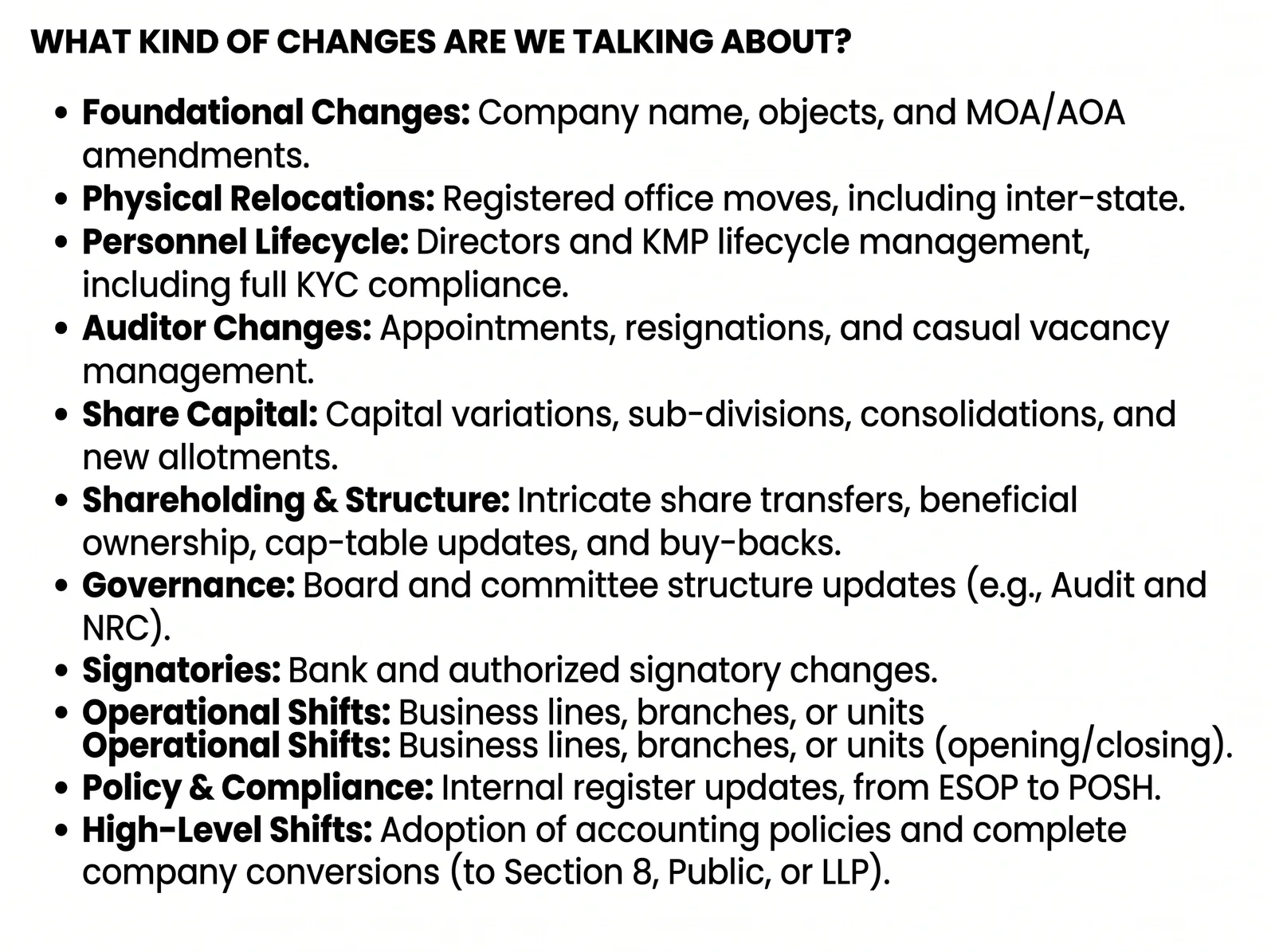
Most growing companies re-work their charter, capital and boards many times — founders come and go, investors enter and exit, new lines are added. The law permits it, if changes are properly documented and filed.

Every change falls into one of three buckets — your corporate constitution, your capital & investors, or your operations & footprint. Each is closely reviewed in due diligence and by regulators.
Charter-level changes to name, main objects or articles — special resolution and a fresh Certificate of Incorporation.
Shift within city, across the State, or between States — with proofs and ROC intimation.
Appointment, resignation or removal of directors, KMP and independent directors.
Appointment, re-appointment, casual vacancy or change of statutory auditor.
Increase / decrease authorised capital and variation of share classes.
Rights, bonus, private placement, ESOP/ESPS and sweat equity issues.
Share transfers, transmission and beneficial ownership / cap-table realignment.
Creation, modification or satisfaction of charges for secured loans; bank signatory updates.
Investor entry/exit synced across ROC, SHA/SSA, ESOP registers and banking lines.
Open / close branches, warehouses, plants or verticals — aligned with GST & local registrations.
Board committees (Audit, NRC, CSR, POSH ICC) and policy/register updates — ESOP, RPT, codes.
To Section 8, public company or LLP where permitted — plus winding up / strike off.
From early-stage pivots to investor-heavy rounds and promoter exits — corporate changes leave marks that are read for years.
Rights issue, ESOP rollout and investor entry in one year — SHA, MOA/AOA, PAS-3, SH-7 and cap-table aligned for smooth VC diligence.
Co-founder exits, a new CEO and an independent director join — clean DIR-12 filings and updated registers, no disqualification gaps.
Registered office shifts across States as the team scales — INC-22 with proofs, plus GST and banking updates kept in sync.
New name and added business objects — special resolution, MGT-14 and INC-24, then a fresh Certificate of Incorporation.
Before you touch any form, we run a quick readiness check — so changes happen in the correct order, with nothing missed.
A guided workflow that keeps every change deliberate, sequenced and fully compliant.
We evaluate your business needs and strategic goals, then chart out what needs to change and in which order.
Board/shareholder resolutions, notices, explanatory statements, altered MOA/AOA, offer letters and transfer forms — all drafted by an experienced CS.
We run the right board and shareholder approvals (ordinary or special resolutions) in line with corporate governance standards.
Accurate filing of the applicable forms (MGT-14, INC-22/24, DIR-12, SH-7, PAS-3, CHG-1/4/9, ADT-1) and response to any ROC queries.
Once approved, statutory records are updated and certificates issued. We keep registers, cap-table and ongoing filings aligned.
We did a rights issue, ESOP rollout and investor entry within the same year. NoLegalPaisa aligned the SHA, MOA/AOA, PAS-3, SH-7 and cap-table so our diligence with a VC fund was completely smooth.
A short walkthrough of how post-incorporation changes work and how we handle the filings for you.
Replace the placeholder with your final NoLegalPaisa company-changes explainer video URL.
A practical guide across the framework, every change type, timelines and workflow.
Post-incorporation changes to a Private Limited company are governed by the Companies Act, 2013, allied rules and Secretarial Standards. Each change has a defined route: a resolution, supporting documents, and one or more ROC forms.
Changes broadly fall into three families — charter & governance, capital & investors, and operations & footprint.
The Memorandum (MOA) sets out the company's constitution and objects; the Articles (AOA) govern its internal management. Amendments are "charter-level" and typically need a special resolution and MGT-14 filing.
Changing the name or main objects is governed by Sections 4, 5, 13 & 14. A name change usually needs a special resolution, MGT-14 and INC-24, and a fresh Certificate of Incorporation before the new identity can be used.
A shift within the city, across the State, or between States has different approval routes. Form INC-22 is filed with proofs such as the lease deed, NOC and a recent utility bill.
Appointment, resignation or removal of directors and KMP is filed in DIR-12, supported by board/shareholder resolutions, consent (DIR-2) and updated KYC. Directors must maintain DIR-3 KYC.
Appointment or re-appointment of the statutory auditor is intimated via ADT-1; a resignation is reported in ADT-3. Casual vacancies follow the Act's prescribed route.
Increasing (or restructuring) authorised capital needs a board resolution, member approval, revised MOA where applicable, and SH-7. Class variations follow the AOA and the Act.
Rights, bonus, private placement, ESOP/ESPS and sweat equity each have their own process. Allotments are reported in PAS-3; private placements use the PAS-4 offer letter.
Share transfers use the SH-4 transfer deed; transmission follows on death/insolvency. Significant beneficial ownership changes are declared via the BEN forms.
Creation or modification of a charge for secured borrowing is filed in CHG-1 (CHG-9 for debentures); satisfaction of a charge is filed in CHG-4 with the lender's NOC.
Investor entry and exit must sync across ROC filings, the SHA/SSA, ESOP registers and banking lines. The cap-table is updated in step with every issue, transfer or buy-back.
Where applicable, companies constitute committees — Audit, NRC, CSR, Risk and POSH ICC — and adopt policies (related-party, CSR, insider-trading style codes).
Opening or closing branches, warehouses, plants or verticals needs alignment across ROC, GST, local registrations, labour and banking relationships.
Filings depend on valid Digital Signature Certificates (DSC) and Director Identification Numbers (DIN). Annual DIR-3 KYC keeps DINs active and avoids deactivation.
Where permitted, a company may convert to a Section 8 company, a public company or an LLP — or wind up / strike off. Each path has its own approvals and forms.
Simple changes like an address update may take 2–3 weeks; complex changes such as capital increases or winding up can take several months. Many forms carry strict filing windows — missing them attracts additional fees and penalties.
Corporate changes leave marks read for years in due diligence and by regulators. Getting the sequence, resolutions and forms right the first time keeps your records clean, deliberate and fully compliant — and your fundraises and exits friction-free.

Clear answers to what founders ask most about company changes.
Clean, deliberate and fully compliant — from a single director update to a full investor round. Tell us what's changing and get a precise, itemised quote.